Rural High School
I'm Thinking of Ending ThingsRural High School is an immense, isolated school that Jake leads the narrator to during a worsening snowstorm. What begins as a proposed place to dispose of cups becomes the setting for the novel’s turn from a fraught drive into a night of fear, entrapment, and revelation: the apparent custodian watching from inside is ultimately identified not as a separate man but as Jake.
Setting and Approach
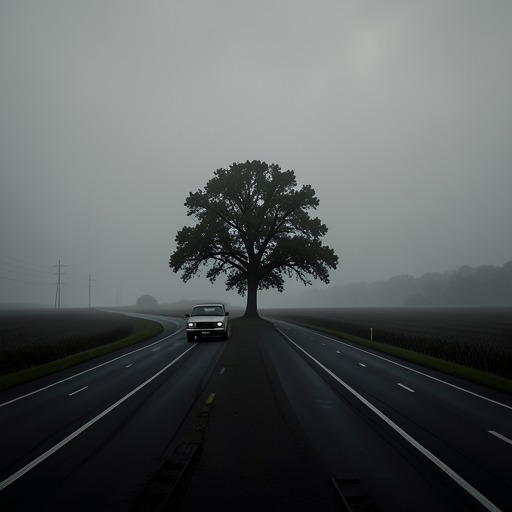
Jake proposes the school as a nearby stop, saying it lies down a road on the left and that the cups can be thrown away there. The narrator questions why the cups need to be discarded and hopes to get home before the weather worsens. Several minutes later, Jake turns onto a road so narrow that it could not accommodate two cars. Dense trees press around it, making the route feel less like an ordinary back road than a passage into a secluded forest.
The school appears only after the car has traveled farther along this constricted road. It is a large, old rural high school, strikingly substantial in such a remote setting. The narrator speculates that it might serve roughly two thousand students, while acknowledging that the actual student body is unknown. The scale of the building and the length of the empty approach sharpen the question of who attends it: the narrator imagines that students might be farmers’ children, bused in from elsewhere, but sees no houses nearby. The school is surrounded by trees and fields, with one road connecting it to the wider landscape.
The Grounds at Night
The school’s isolation becomes more threatening after Jake walks away from the car carrying the cups. There are no streetlights along the back road; a single yellow floodlight on the school roof provides the only illumination. When the narrator switches off the car’s headlights, the parking area disappears into darkness. The surrounding space seems vast, and falling snow grows heavier. The school is visible, but its remoteness offers no reassurance: there are no nearby homes or other signs of help.
Jake does not return promptly. The narrator calls for him and hears repeated loud bangs, with the fourth sounding loudest and apparently coming from inside the building. Cold enters when the car door is opened, and the narrator regrets having agreed to the trip, the visit to Jake’s parents, and the detour to the school. That regret is bound up with a more general wish to end the relationship, but the immediate danger changes the meaning of solitude: a person who usually values being alone now does not want to be alone here. The school grounds turn an empty landscape into a condition of exposure, where the narrator cannot see what Jake is doing or where the sounds originate.
Windows and the Custodian
The school’s windows make the boundary between the dark grounds and the interior unnerving. The narrator reports that Jake saw a man standing motionless at a window, staring toward the car, and wonders whether he was a night worker or janitor. The narrator imagines the work of a solitary custodian: cleaning after students have left, moving at an unhurried pace, and remaining unnoticed by the people whose mess is his responsibility. The thought makes night custodial work seem appealing for its solitude, even as the school’s distance from other people makes the job sound isolating.
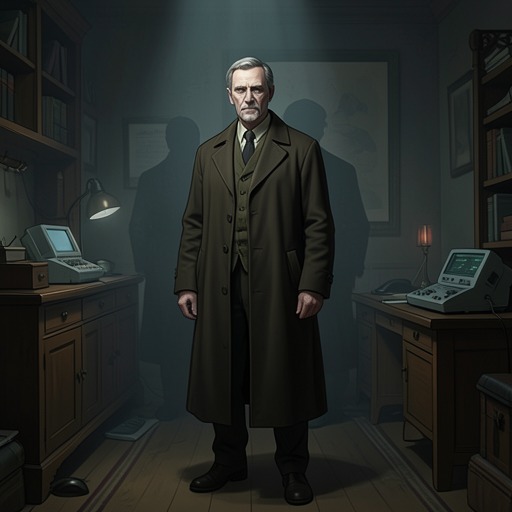
Elsewhere, the narration gives this imagined custodian vivid particulars: shaggy hair and glasses, slow sweeping, and a loud recording of a single voice telling a story on a portable player. He is described as meticulous and unaware of the narrator. Yet the account later unsettles the apparent certainty of this image. At the climax, the narrator insists that no one saw a man inside the school; only Jake claimed to have seen him. The custodian is therefore not a securely established occupant of the building. The change in the account makes the school’s watcher a central point of uncertainty, and turns the earlier image of routine cleaning into part of a narrative whose perceptions cannot be taken at face value.
Entering the Building
After waiting in the car and hearing the bangs, the narrator leaves it and approaches a window. From about thirty feet away, the narrator can make out floor-to-ceiling blinds and, behind them, bookshelves in what appears to be a library or office, but cannot see anyone through the gaps. Knocking on the cold glass produces no access or answer. The narrator then checks a green garbage can Jake had indicated. It is half full of beige salt, and its lid is dented and warped; the cups have not been disposed of as expected. Unable to face returning to the car and still needing to find Jake, the narrator follows his faint steps around the side of the school.
Inside, the school is a sequence of ordinary institutional spaces that acquire a different force as the narrator becomes trapped. The route includes woodworking and auto classrooms, a door marked Dance Studio, another marked Student Council, and the drama department. The group does not try those doors. The narrator’s later account describes passing these familiar rooms and floors without treating them as possible exits, as though their repetition has made the school’s interior inescapable. The custodian’s room becomes the place the narrators understand themselves to be destined to reach. Familiarity does not make the building safe; it narrows the sense of what remains possible.
Revelation and Significance
The final return to the custodian’s room reframes the school’s earlier events. The room is empty of the supposed worker, and the narrators understand that the custodian is already gone. They conclude that Jake wanted the narrator to follow him inside, into a place with no way out. The school’s promise of a simple errand has thus become a route into confinement, and the man at the window is exposed as part of that design rather than a separate night employee.
The recognition extends to the gym’s locker room, where Jake’s shoes were left after he removed them and put on rubber boots. The narrator connects the boots, the alleged man, and Jake: Jake was the figure all along. At the same time, the narrative’s voice fractures into a collective “we,” making the school more than the setting for a pursuit. Its custodial room becomes the point where separate identities and accounts converge, and where the narrator recognizes that the story of Jake’s troubled brother was made up. The building’s empty halls, unseen interiors, and rooms passed without being entered give physical form to the story’s final narrowing of possibility: the school first looks like a place to stop, then a place to search, and finally the place where the identities behind the apparent pursuit are revealed.